
Juan Murillo Arias
We are launching the Cambium blog
It has been over two years since Cambium was launched, and during this time we have been able to reflect, learn and try out many different approaches to creating the best forestry projects for mitigating global warming. With this blog, we want to share some of our learnings and reflections with you to open up the debate on these issues. We will periodically address different topics, as this field is very broad.
Mitigation of global warming is such a complex challenge that no single solution is going to be the unique key to solve it, but a combination of multiple actions. While the priority must be set in emissions reductions on its sources, the remaining emissions can be offset outside the value chain of the companies responsible of those emissions acquiring carbon credits in the voluntary markets, to complement their decarbonization plans and accelerate the achievement of their net-zero commitments.
The diversity of project types that enable those emissions offsets is huge. Among them, at Cambium Earth we are focused in the generation of high-integrity carbon credits through the development of nature-based solutions (NBS), more specifically, Afforestation, Reforestation and Revegetation (ARR) projects.
While anthropogenic carbon dioxide global emissions from fossil fuels and industry have reached 38 tCO2/year (59 tCO2e/year¹ including all greenhouse gasses), IPCC estimates² that afforestation projects could make substantial contributions to carbon removal goals by mid-century:
¹Dhakal, S., J.C. Minx, F.L. Toth, A. Abdel-Aziz, M.J. Figueroa Meza, K. Hubacek, I.G.C. Jonckheere, Yong-Gun Kim, G.F. Nemet, S. Pachauri, X.C. Tan, T. Wiedmann, 2022: Emissions Trends and Drivers. In IPCC, 2022: Climate Change 2022: Mitigation of Climate Change. Contribution of Working Group III to the Sixth Assessment Report of the Intergovernmental Panel on Climate Change [P.R. Shukla, J. Skea, R. Slade, A. Al Khourdajie, R. van Diemen, D. McCollum, M. Pathak, S. Some, P. Vyas, R. Fradera, M. Belkacemi, A. Hasija, G. Lisboa, S. Luz, J. Malley, (eds.)]. Cambridge University Press, Cambridge, UK and New York, NY, USA. doi: 10.1017/9781009157926.004
²Nabuurs, G-J., R. Mrabet, A. Abu Hatab, M. Bustamante, H. Clark, P. Havlík, J. House, C. Mbow, K.N. Ninan, A. Popp, S. Roe, B. Sohngen, S. Towprayoon, 2022: Agriculture, Forestry and Other Land Uses (AFOLU). In IPCC, 2022: Climate Change 2022: Mitigation of Climate Change. Contribution of Working Group III to the Sixth Assessment Report of the Intergovernmental Panel on Climate Change [P.R. Shukla, J. Skea, R. Slade, A. Al Khourdajie, R. van Diemen, D. McCollum, M. Pathak, S. Some, P. Vyas, R. Fradera, M. Belkacemi, A. Hasija, G. Lisboa, S. Luz, J. Malley, (eds.)]. Cambridge University Press, Cambridge, UK and New York, NY, USA. doi: 10.1017/9781009157926.009
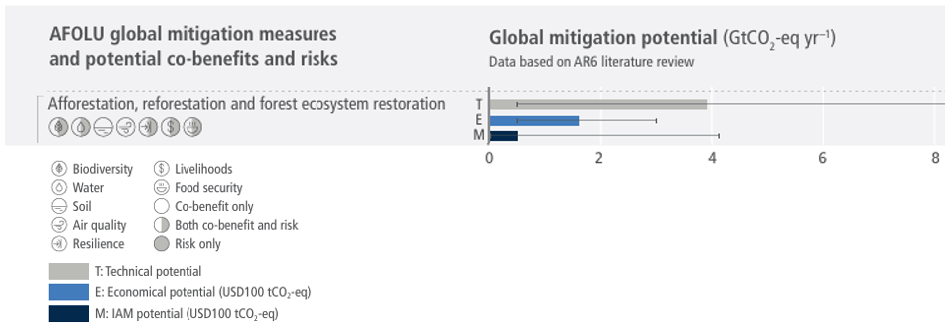
Global mitigation potential of ARR projects
Source: Agriculture, Forestry and Other Land Uses (AFOLU). IPCC, 2022. Page 778.
However, the potential of ARR projects must not get into conflict with food security and biodiversity, aspects for which it competes for the use of a finite resource such as fertile land. Since the Neolithic period, a third of all global forests have been cleared to create farmland and pasture for livestock³. With 8 billion people on the planet, we must use the soil responsibly while trying to reverse the degradation of areas with forestry potential, combining ecosystem improvement efforts with high performance in terms of CO2 removal.
Challenges in the development of ARR projects
As ARR projects proponents and developers, we face the following challenges:
Firstly, carbon credit prices on the voluntary market are still below what they should be for these types of solutions to scale up and offer attractive returns for their developers and funders. While the average carbon credit price for forestry projects is around $15.5 per ton of CO₂, the social cost of carbon—what society truly pays in damages from emissions—is estimated at $51 to $150 per ton. This gap shows how undervalued forestry projects are in financial markets, but despite this present situation, ARR projects are developed for the long run, and in the next years a high increase on carbon credits prices is expected, and the IPCC itself defined future scenarios under a hypothetical future revenue of $100 per ton, which would create adequate incentives to extend this type of initiatives.
Secondly, given a project location within an specific biome, tree species used in carbon projects can be very broadly divided into two big groups: non-invasive species exotic to the biome, and native species characteristic of that ecosystem.
On one hand, fast-growth exotic species have been the backbone of the timber-producing sector for many decades, if not at least a couple of centuries. Genera like Eucalyptus spp or Pinus spp have been artificially enhanced by selecting the best trees in terms of growth, pest or drougth resistance, among other features, and promoting their reproduction. These improved species have been exported and planted worldwide regardless of their geographical origin.
³Max Roser (2022) – Humans destroyed forests for thousands of years — we can become the first generation that achieves a world in which forests expand Published online at OurWorldinData.org. Retrieved from: ‘https://ourworldindata.org/global-forest-transition’
⁴State and Trends of Carbon Pricing 2025, World Bank
⁵Global forests store vast carbon wealth but credit systems undervalue their true potential, by Sumanta Das
⁶Dr. Steve Hatfield-Dodds, Matthew Cowie, Emma Herd, Paul Boulus, Can carbon become a new commodity class?
Some of them are considered invasive, and they cannot be used in ARR projects, but others are allowed as they have not shown invasive behavior.
On the other hand we count with those species that are native to the biome where an ARR project is developed. Their growth is usually slower than that of the aforementioned improved genera, but their plantation keeps biodiversity in wealthy levels, and must be the core of ecosystem restoration projects; although not all ARR projects must pursue restoration aims, indeed it is always desirable to achieve positive environmental impact beyond CO2 removals. The real challenge is to balance this goal with the needed high-growth performance required to create any ARR project that must be sustainable also from an economic perspective when using the slower growing native species.
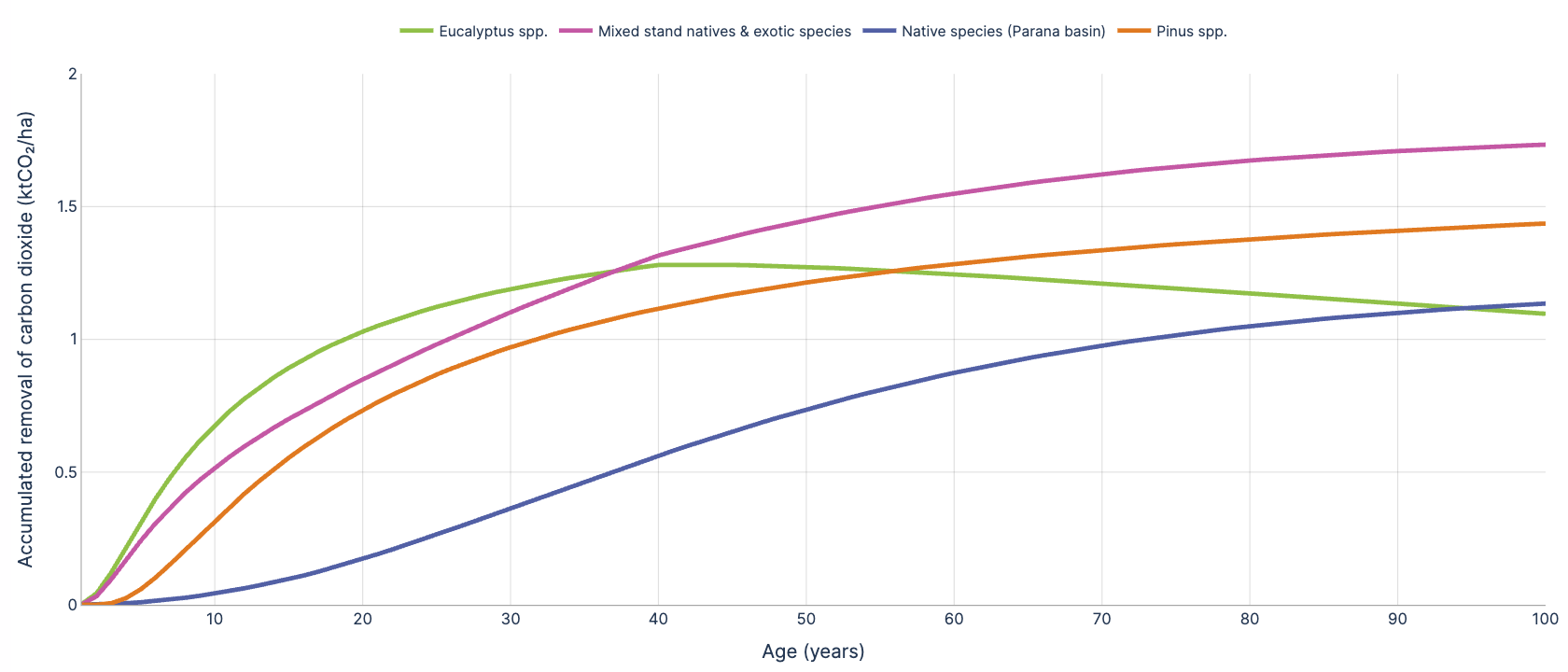
CO2 stock per hectare removed by different species or mix of species throughout 100 years
Source: Cambium Earth
End customers should not have to wait for many years to get their carbon credits, and for any developer supporting a business model without income in that first period is financially challenging.
Our approach
At Cambium Earth we take an innovative approach to Nature-Based solutions that sets us apart in the carbon market: We always include a diverse set of native tree species in our projects in different proportions, ensuring long-term project environmental benefits, but we also use fast-growing species to maximize short-term carbon sequestration.
In some of our projects exotic species are harvested, providing income from the timber sold, but in others we let them grow together with the native species, covering the gap in carbon credits generation during the first years. This combination helps balance credit generation across the crediting period, creating a steadier flow of credits. Given that current carbon credit prices remain still below the true social cost of carbon, producing more credits in the early years ensures economic viability, until market conditions improve. On the contrary, in other projects we renounce to harvest, and this has a positive economic effect as the rating agencies assess those projects without commercial extraction of timber as more additional than harvested ones, what increases the unitary carbon credit value.
At the same time, and in cooperation with academic institutions, we are carrying out our best efforts in research and development to improve the knowledge and performance using native species.
Forestry designs that promote coexistence between species
Our projects are developed on severely degraded lands that endured decades of cattle raising activities: seasonal fires to create new pastures, soil compacted by livestock and thus more impermeable, low organic matter levels and strong insolation are challenging conditions for the successful establishment of non-pioneering native species, however, fast-growth species can resist those hard conditions thanks to their characteristics.
Fast-growth non-native species can play a relevant ecological role, as they create the proper environment for native species to grow: They provide shadow, average out minimum and maximum temperatures, and enhance the short daily water cycle through evapotranspiration during the day and dew at night and dawn.
For those reasons, when planted at low density, they create what is called a “nursery effect”, a non-harvested plantation of exotic species can evolve towards a secondary forest throughout the years. The spontaneous growth of native species is reinforced by seeds brought in by the wind or the fauna, complementing our own planting activities of native species in mixed projects that use both groups of trees.
As previously mentioned, in our projects we can decide whether to harvest or not, as both approaches are compatible with carbon projects development frameworks. Harvesting will reduce a lot the generation of carbon credits, providing on the other hand an early income through the timber commercialization. However, at Cambium we are making a big bet for carbon credits, and we pursue to maximize CO2 removals. That is why in our last projects we have renounced harvesting and timber production, and this is also applied to non-native non-invasive species. By not harvesting native tress nor fast-growing trees we enhance carbon permanence and maximize long-term climate benefits in projects that can last between 40 and 100 years.
We have worked with a pool of 32 different native species so far, and are planting them following different designs, in some cases among eucalyptus or pines in mixed strata, where they provide edible fruits that enhance livability conditions for fauna within our plantations.
⁷Montiel, María del Rosario. Doctoral thesis Determinantes de la regeneración arbórea nativa en áreas de bosque y pastizal del norte de la provincia de Corrientes, Argentina
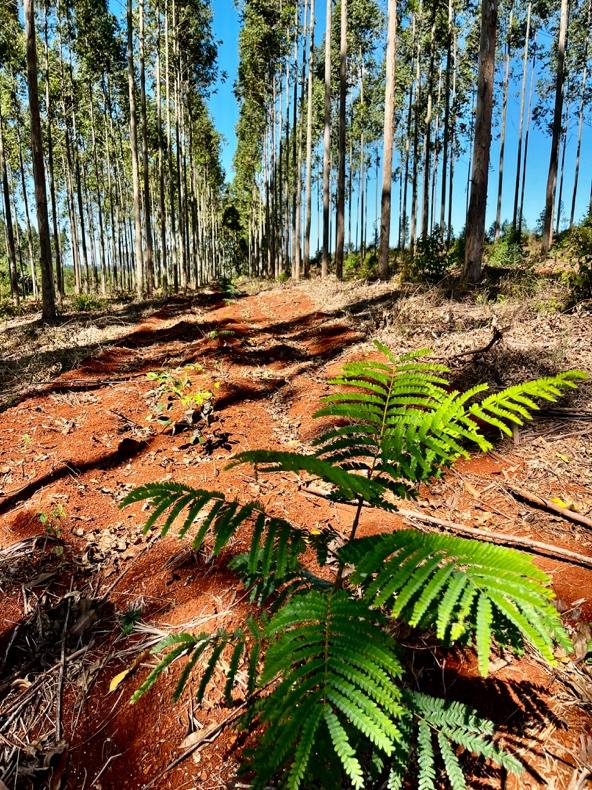
Native species planted among eucalyptus in our project Paraná-1
Source: Pomera Maderas
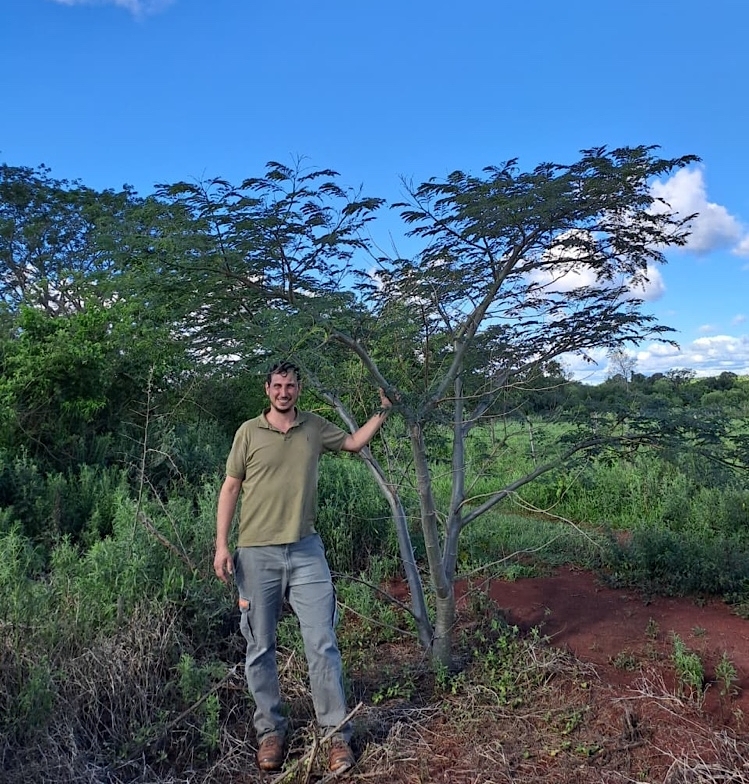
Two years old native tree Enterolobium contortisiliquum (timbó colorado) in our project Paraná-3
Source: Pomera Maderas
In other cases, we group native species in pure bands surrounding fast-growth species plots. Given its higher fire resistance, they act as firewalls and biodiversity corridors:
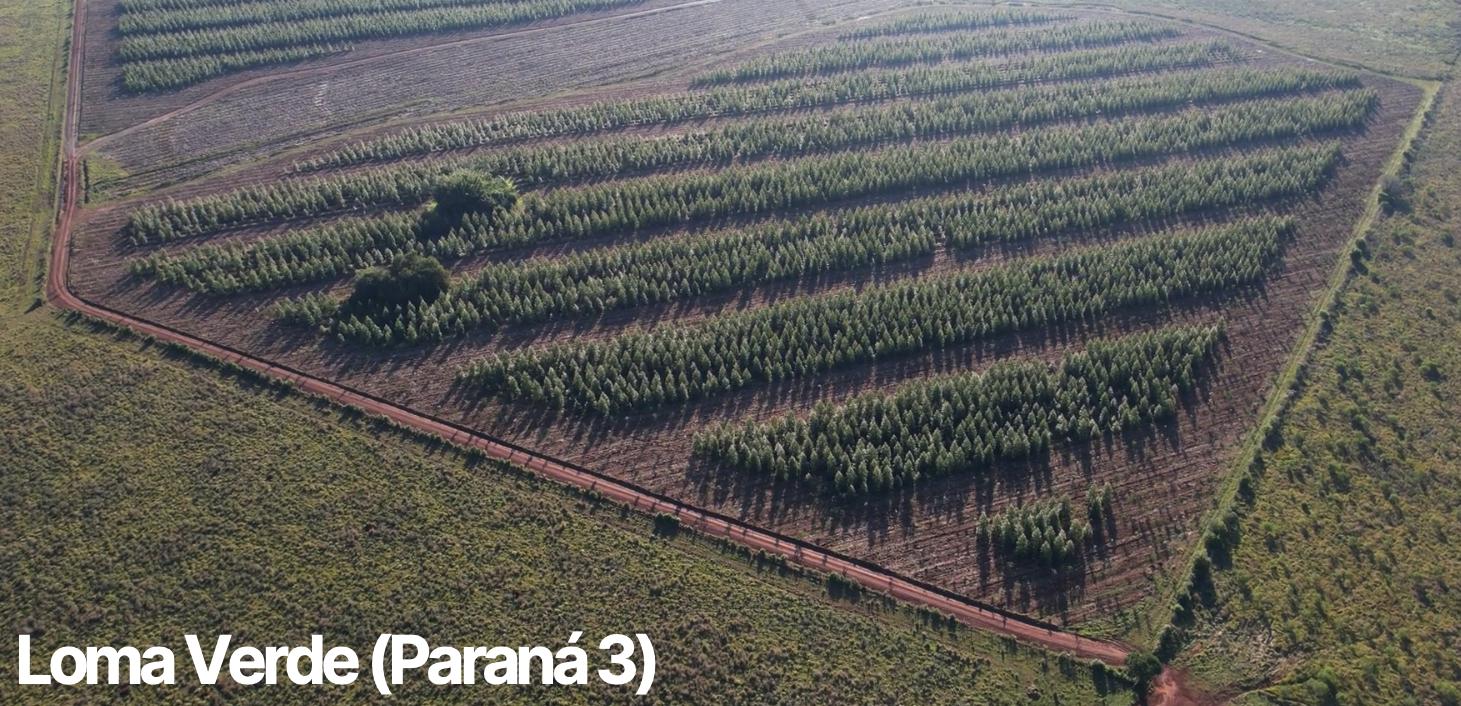
Aerial view of our project Paraná-3 with the pure corridors of native species design
Source: Pomera Maderas
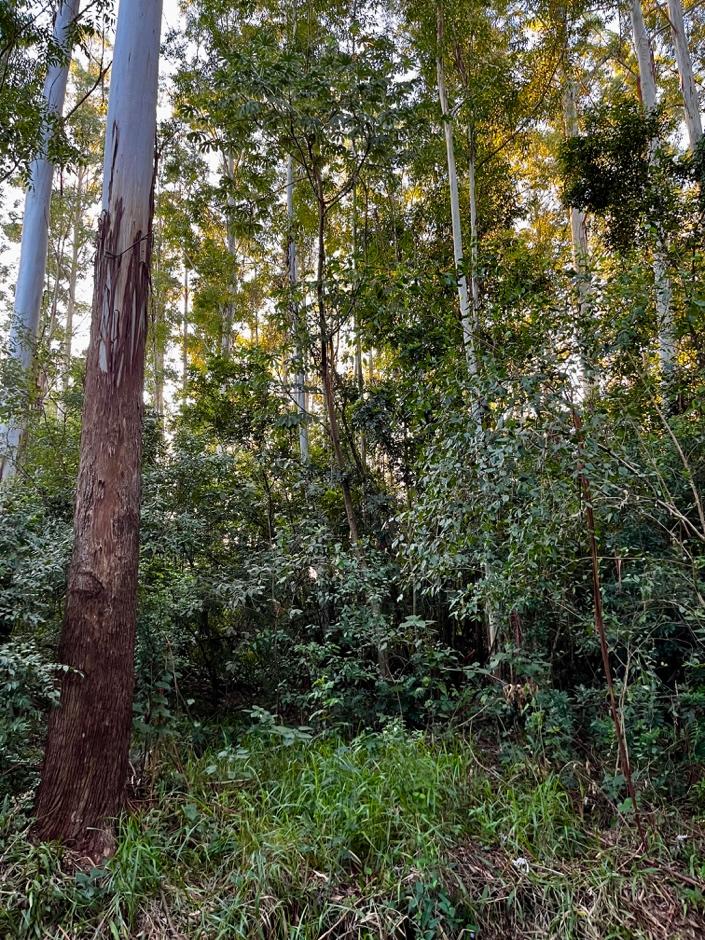
Non-harvested eucalyptus plantation in Puerto Valle in regeneration thanks to spontaneous native plants growth in progress
Source: Cambium Earth
We will also measure the pace at which non-harvested fast-growth species plots are colonized by native species⁸ due to their nursery effect and depending on their initial plantation density. That will provide us with valuable information to enable spontaneous regeneration and fostering the transition of non-harvested plantations into secondary forests in the long-term.
Besides, harvesting avoidance brings also multiple environmental advantages: Without soil preparation works after every harvest cycle, organic matter oxidation is also avoided, avifauna is not disturbed by forestry operations, nests remain on place, and terrestrial fauna find a continued refugee within the plantation.
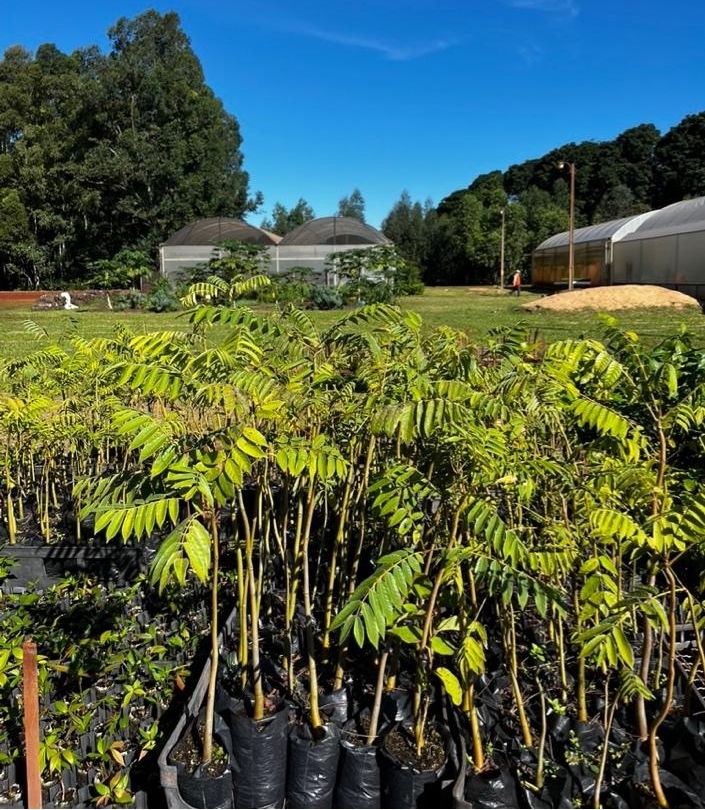
Native species seedlings in Pomera Maderas’ tree nursery
Source: Cambium Earth
⁸Laura H. P. Simões, Joannès Guillemot, Carlos C. Ronquim, Emanuela W. A. Weidlich, Bart Muys, Matheus S. Fuza, Renato A. F. Lima, Pedro H. S. Brancalion. Green deserts, but not always: A global synthesis of native woody species regeneration under tropical tree monocultures
Last, but not least, we do not renounce to develop pure ecosystemic restoration projects in the near future using only native species, for that purpose we encourage corporate partners to engage with our activity and act as off-takers of our projects if they feel they can help develop such projects with the return of maximum quality carbon credits.
While the science of forestry carbon projects is still evolving and the carbon markets continue to mature, we humbly acknowledge that there is no single ‘best’ approach, that is why we are developing a diversified portfolio of projects. We remain committed to learning and adapting as new knowledge and opportunities emerge, steadily improving the performance and sustainability of our plantations. These principles define our identity and establish us as an innovative and trustworthy player in the carbon sector.